What happens when you ask
an AI assistant?
Every query you send to an AI assistant passes through a series of carefully designed steps — from the moment you press send to the moment the answer appears on your screen.
It’s not just “copy-paste” from the internet
The AI assistant does not search the web like Google. Instead, it understands the context of your question, combines its own knowledge with available sources, and composes an answer tailored specifically to you.
It all happens in a fraction of a second
The five stages of processing, checking, and generating a response that we describe below are completed by the AI in under a second — and repeated fresh for every single query.
Why does understanding this process matter?
Many users and businesses picture AI assistants as advanced search engines: type a question, get a result. The reality is considerably more sophisticated — and, in practice, considerably more useful. Every query passes through six interconnected stages that together ensure the response is not only accurate, but also appropriate, safe, and tailored to the person asking.
Understanding this process helps businesses configure their AI assistants more effectively, set realistic expectations, and identify situations where an assistant can deliver the most value. For users, it helps them ask better questions and get the most out of every interaction.
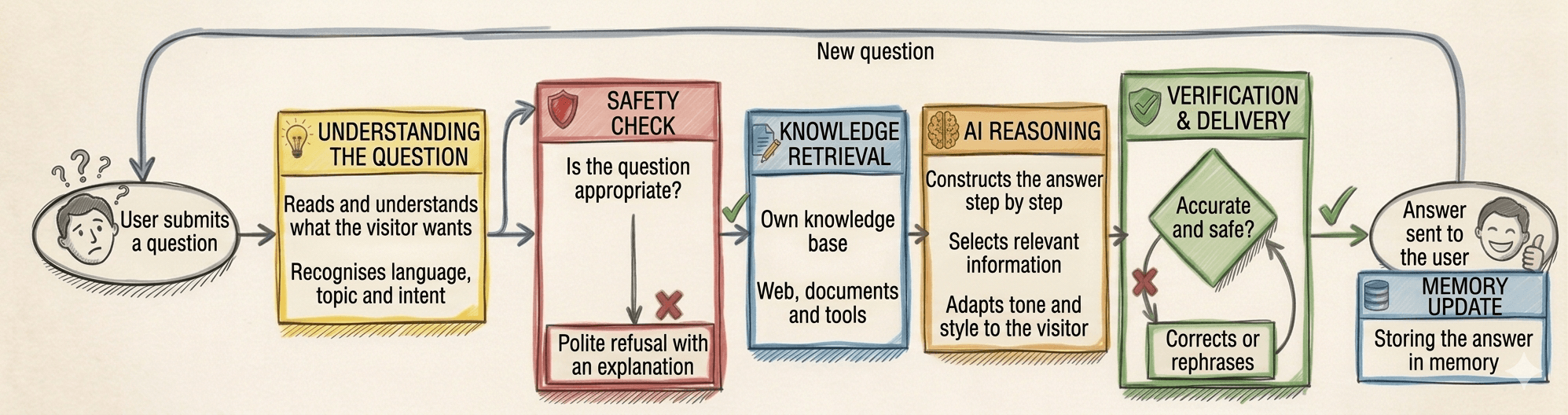
Every query travels this path from left to right — from visitor to answer.
Visitor asks a question
The conversation starts the moment a visitor types a message, sends an image, or attaches a document. The AI assistant receives the input and begins processing it.
Understanding the question
The AI doesn't read the question literally. It analyses what the visitor actually wants, recognising the topic, context, and intent — even when the question is incomplete or unclear.
Safety check
Every question goes through an automated safety check. If the content is inappropriate or potentially harmful, the AI politely declines to answer and explains why.
Knowledge retrieval
The AI searches all available sources: it remembers what was said earlier in the conversation, queries its knowledge base, and — if enabled — consults the web, other AI agents, or uses tools for API data retrieval.
AI thinks and composes the answer
This is the core of the process. The AI builds the answer step by step, evaluates which information matters most, and adapts the tone and style to the specific visitor and situation.
Review and delivery
Before the answer reaches the visitor, the AI checks once more whether it is accurate, helpful, and safe. If not, it steps back and refines it.
Visitor asks a question
Everything begins the moment a visitor opens the chat and types their first sentence. That moment matters more than it seems. The AI assistant immediately picks up much more than just the text. It notes the context of the page the visitor is on, remembers everything said earlier in the conversation, and takes into account the format of the message — whether it is a short query, a lengthy explanation, or just a few keywords.
Unlike search engines that react to keywords, the AI assistant receives the full situational context. This means visitors do not need to phrase their question perfectly. The assistant will understand the intent even if the question is incomplete, grammatically imperfect, or written in a different language.
Understanding the question
This is the step that makes AI assistants fundamentally different from classic chatbots. Traditional chatbots operate on keyword matching. If a visitor types "room", the system searches for answers containing that word. An AI assistant does the opposite: instead of looking for a match, it understands meaning.
Concretely, if a hotel visitor types "do you have anything available this weekend?", the system will not search for a response to the phrase "available this weekend". It will understand that this is an availability enquiry, take the conversation context into account, and prepare to retrieve the relevant information. The same logic applies to e-commerce, service businesses, or any other business context.
Safety check
Before the assistant starts looking for an answer, every query goes through an automated safety check. This stage protects both visitors and your business. If a question is inappropriate, malicious, or falls outside the domain for which the assistant is configured, the system recognises this and politely declines to answer with a brief explanation.
For businesses, this is especially important. Your AI assistant will not respond to questions unrelated to your operations, will not share confidential internal data it should not share, and will not be manipulated by techniques attempting to bypass its rules of conduct. The safety layer is invisible in normal use, but it is always active.
Knowledge retrieval
Once a question passes the safety check, the assistant begins searching its knowledge. This process is not linear. The system simultaneously searches multiple sources and combines information from each of them to compose the most accurate answer possible.
The first source is conversation memory — everything the visitor has said earlier in the same session. The second source is your business knowledge base, which includes data, descriptions, instructions, and information you provided during the assistant's configuration — and additionally, connections to your CMS, ERP, or other internal systems can be set up. The third source, if enabled, is external tools such as API connections or web search. Thanks to this combination, the assistant does not give generic answers — it gives answers that are accurate for your specific context.
AI thinks and composes the answer
This is the core of the entire process and what sets modern AI assistants apart from everything that came before. The assistant does not retrieve a pre-written answer and deliver it. Instead, it composes one from scratch — for every question, in real time, based on everything gathered in the previous steps.
The generation process unfolds step by step: the assistant evaluates which information is most important, decides the order in which to present it, and adapts the tone and style to the situation. A formal query receives a formal answer. A casual conversation receives a more relaxed tone. If the visitor communicates in English, the response arrives in English — without any manual intervention.
Review and delivery
Before the answer reaches the visitor, the system undergoes a final internal review. The assistant evaluates its own response: is it relevant to the question asked, is it accurate relative to the available knowledge sources, and is it safe to deliver? If the answer does not meet these criteria, the system automatically revises or reformulates it.
Only after this check is the answer delivered to the visitor — typically within one to two seconds of the moment the question was asked. In parallel, the conversation is stored in memory, meaning that every subsequent question in the same session produces an increasingly contextual and precise response. The assistant learns how the conversation flows and becomes more useful the longer it continues.
Technology that works for you, not instead of you
An AI assistant is not a replacement for human contact. It takes over repetitive, time-consuming communication tasks so your team can be where they are truly needed. Every step of this process is designed with one goal in mind: to deliver the right answer, to the right person, at the right moment.
Schedule a demo