In 2021, Croatia issued just under 82,000 residence and work permits for foreigners. Four years later, that number reached 206,529 — a 152% increase in just a few years. Even in 2025, a year in which the total number of permits fell to 170,723, foreign workers represent a structural, not temporary, part of the Croatian labor market.
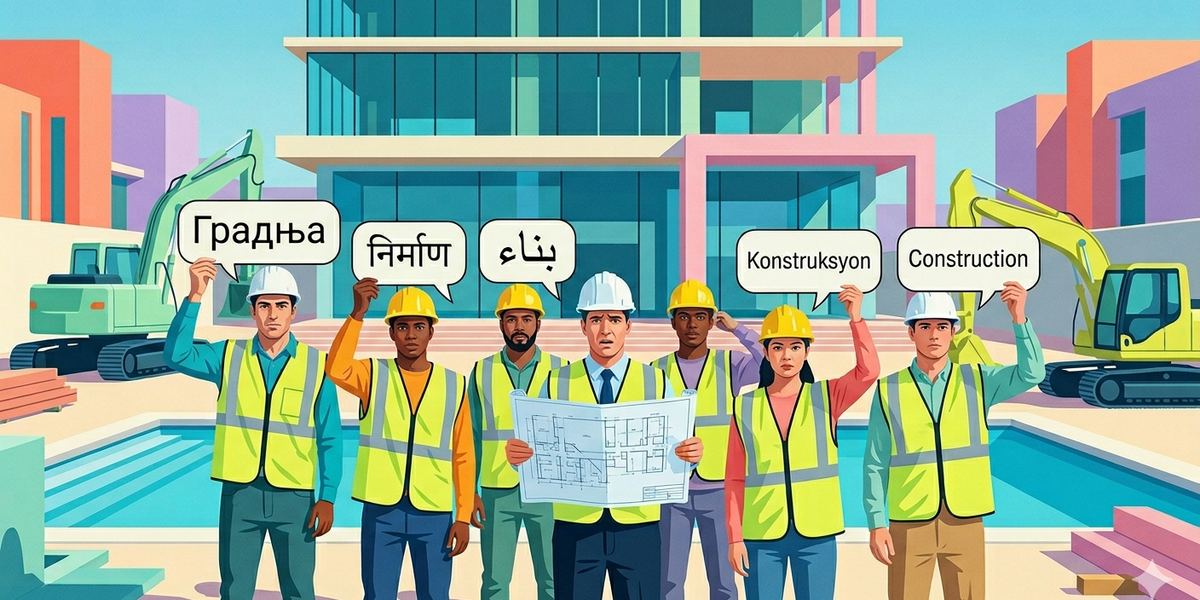
Behind those numbers lies a question many employers still do not ask out loud: how do we communicate with these people?
Who Are the Foreign Workers in Croatia, Really?
Data from the Ministry of the Interior for 2025 reveals a picture far more complex than the generic category of “foreign worker” (see Figure 1.).
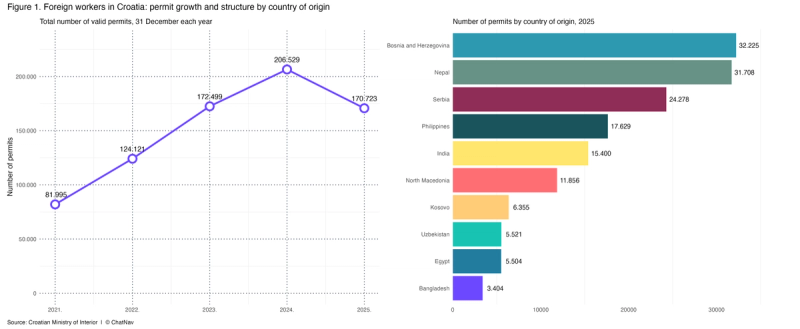
At the top of the list is Bosnia and Herzegovina with 32,225 permits, followed closely by Nepal with 31,708 permits, then Serbia (24,278), the Philippines (17,629), India (15,400), North Macedonia (11,856), Kosovo (6,355), Uzbekistan (5,521), Egypt (5,504), and Bangladesh (3,404). The top ten countries together account for 153,880 permits, or 90.1% of the total.
If we exclude workers whose native language is related to Croatian — i.e., Bosnia and Herzegovina, Serbia, North Macedonia, and Kosovo — we arrive at 74,714 workers, or 43.8% of the total. The remaining 79,166 workers (46.4%) speak languages with no structural connection to Croatian: Nepali, Tagalog, Hindi, Uzbek, Arabic, and Bengali. In other words, every other foreign worker in Croatia understands neither Croatian nor any related language.
Where Do These Workers Work?
The sectoral breakdown for 2025 (see Figure 2.) shows two dominant industries that together absorb nearly two-thirds of all foreign workers: Hospitality and Tourism with 52,858 workers (31.0%) and Construction with 52,776 workers (30.9%).
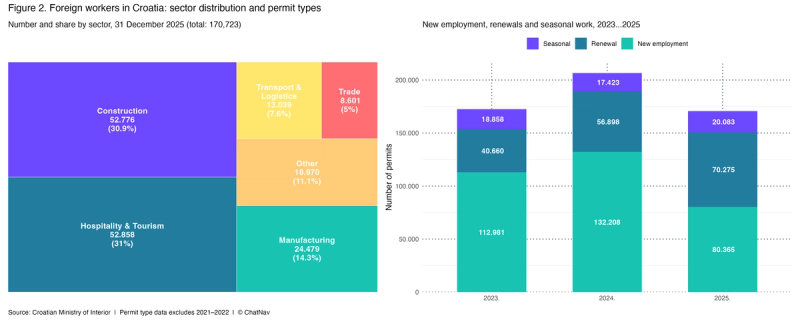
What this distribution conceals is the difference in the nature of the work. In tourism and hospitality, the language barrier directly affects the quality of service — a worker who does not understand an instruction or cannot communicate with a guest becomes a visible problem. In construction, the language barrier becomes a safety risk: a misunderstood instruction on a construction site is not merely a communication inconvenience.
Particularly noteworthy is the dynamics of permit types (right chart, Figure 2.): of the total 170,723 permits in 2025, almost half are new hires. Every new hire means a new worker who needs to be introduced to rules, procedures, and the work environment. In addition, 20,083 permits are seasonal — these are workers who arrive on short notice, usually just before the tourist season, and who need to be onboarded quickly and efficiently, where time is a luxury.
Language as an Invisible Barrier
Figure 3. shows what dry data cannot convey: it is not enough to know how many foreign workers there are — the key is to understand who speaks what and where they work.
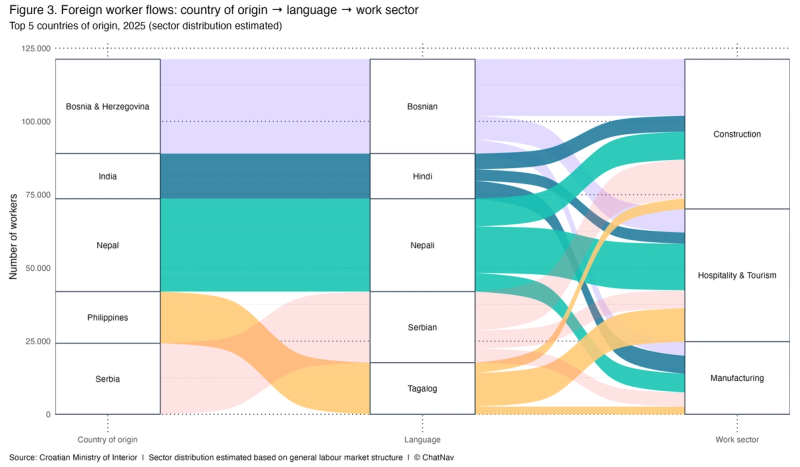
Bosnian, the language with the largest number of speakers, flows mainly toward construction and industry — sectors with high physical demands and precise procedures. Nepali and Hindi are distributed more evenly, but also with an emphasis on construction. Tagalog, the language of Filipino workers (17,629 in 2025), gravitates predominantly toward hospitality and tourism. Serbian covers industry and construction.
What this overview clearly shows: there is no single foreign language that dominates. There are about a dozen highly represented language groups, spread across different sectors, requiring from employers a communication capacity that only a handful of Croatian employers can afford in the classical HR sense.
Concrete Problems Employers Prefer Not to Admit
1. Onboarding That Takes Too Long
With 80,365 new hires in 2025, onboarding is not a one-time project but a continuous operational process. Introducing a new worker who speaks neither Croatian nor English to the rules, procedures, and workplace culture without adequate tools means either hiring a translator, relying on colleagues who speak the same language, or skipping onboarding and hoping the worker will “figure it out on their own.”
All three options come at a cost: translators are expensive and unavailable 24 hours a day, relying on colleagues creates informal hierarchies and the risk of misinformation, and skipped onboarding directly translates into errors, accidents, and high turnover.
2. Safety Instructions as Dead Letters
In construction, which in 2025 counts 52,776 foreign workers, safety protocols are a legal obligation and a matter of life. Instructions for operating machinery, incident procedures, rules on protective equipment — all of this must be understandable to a worker who has been on the construction site for only a few days. If this information exists exclusively in Croatian, for a significant portion of workers it effectively does not exist.
3. Seasonal Peaks as Organizational Collapse
In coastal counties — for example, Istria (24,456 permits), Split-Dalmatia (17,448), Primorje-Gorski Kotar (15,421), and Dubrovnik-Neretva (12,553) — foreign workers arrive in waves just before or even during the season itself. Hotels, restaurants, and campsites must onboard a large number of workers speaking Nepali, Tagalog, or Arabic in a short time, while the HR teams that should handle this typically do not exist or are too small.
4. Everyday Communication That Consumes Working Time
Shift schedules, workplace changes, sick leave, salary, overtime hours — all of this is information workers need daily. Without a system that can convey this information in a language the worker understands, every such query ends up on the manager’s desk, in an informal conversation that consumes the working time of both parties.
A Foreign Worker by Day, a Consumer by Night
There is a dimension of this phenomenon that employers rarely consider, but which is becoming increasingly relevant to the broader business ecosystem: 170,723 foreign workers are not just a workforce — they are also consumers.
A worker from Nepal working on a construction site in Istria orders goods online, eats at restaurants, uses local services, rents an apartment, and sends money home. A worker from the Philippines employed at a hotel in Split shops at stores, uses healthcare services, and may one day plan to stay longer than the season. Each of them interacts daily with dozens of businesses, and each of those contacts passes through a language barrier.
For companies in sales, services, or rentals, foreign workers in Croatia represent a consumer segment that grows year after year, yet remains inadequately addressed. A webshop that communicates only in Croatian, a chatbot that only understands standard queries in English, or customer support that has no capacity for Nepali or Tagalog — these are all systems that de facto exclude this segment.
This is not just a question of inclusion. It is a question of missed opportunity. A segment of nearly 80,000 workers who speak languages completely foreign to the Croatian-speaking area represents significant market potential that remains untapped precisely because of the communication barrier.
An AI assistant that speaks Nepali, Tagalog, or Hindi is not just an HR tool for employers. For companies oriented toward the end consumer, it is also a tool for acquiring and retaining customers from a segment that conventional marketing and support do not reach.
Why Standard Solutions Do Not Scale
The most common response to the language barrier in practice is a combination of three approaches: a formal translator, Google Translate, and “we manage somehow.” Each of them can work at a small scale, but none of these solutions scale.
A company with five foreign workers who speak Nepali can rely on one bilingual colleague. A company with two hundred workers who speak Nepali, Tagalog, and Hindi simply cannot. And precisely such companies — especially in construction and tourism — have become the norm in the 2020s.
Here is the reformulated section — without qualifiers, focused on concrete applications:
How an AI Assistant Helps Bridge the Language Barrier in the Workplace
The language barrier in the workplace has concrete, everyday manifestations, and for each of them an AI assistant provides a practical answer.
Onboarding in the worker’s language. Knowing a rule and understanding why it exists are two different things. A new employee can have an unstructured conversation with the assistant in their own language, ask questions, and receive context that standard onboarding materials do not convey.
Everyday queries without intermediaries. A worker who needs to know the shift schedule for the following week on a Sunday morning does not wait until Monday. They ask the assistant in their own language and receive an accurate answer.
Scalability during seasonal peaks. When 200 new workers arrive before the season, the communication burden does not fall on one or two HR team members. The assistant handles queries simultaneously, in multiple languages, without any reduction in response quality.
Consistency of information. Information passed through colleagues is subject to interpretation, selection, and error. The AI assistant gives the same, accurate answer — every time, to every worker.
Reach toward consumers. For companies that recognize foreign workers as a consumer segment, an assistant that communicates in their language is not just an internal communication tool, but also a channel to a customer that standard communication does not reach.
The Number Is Argument Enough
170,723 permits in 2025. Nearly half for workers who speak languages completely foreign to the Croatian-speaking area. Almost every other new permit is for a worker who needs to be introduced to the work environment from scratch.
The language barrier is not an abstract problem solved by goodwill. It is an operational challenge that grows alongside the numbers — and those numbers have no plans to decrease.
The number of foreign workers in Croatia doubled in four years. The communication tools that keep pace with this must be equally scalable. An AI assistant like ChatNav grows alongside that number — more workers, more languages, more queries — without a proportional increase in costs or team workload.