The Most Common Hotel Front Desk Problems and How an AI Assistant Solves Them
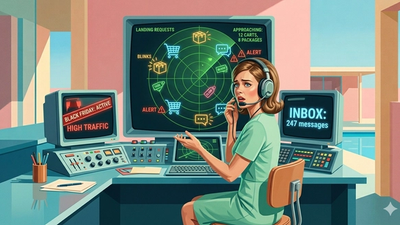
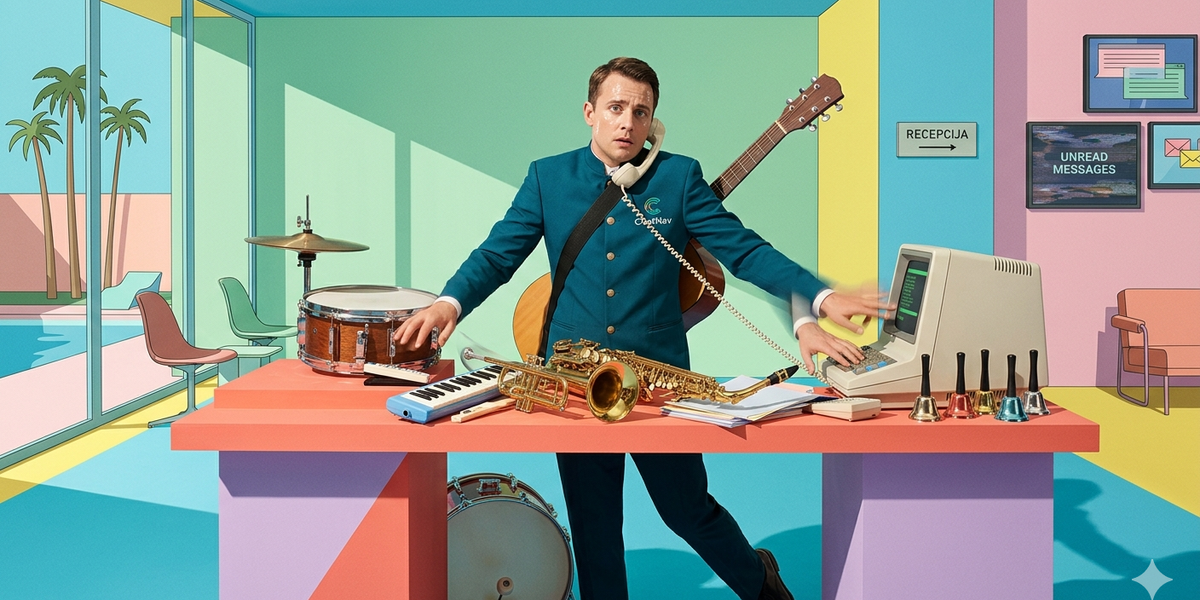
You arrive at the hotel. Five people are already waiting at the front desk. The receptionist is answering the phone, typing something into the computer, and simultaneously trying to explain to a guest where the elevator is. Behind her, on the screen, several unread chat messages are blinking.
This is not an exception. This is a typical day at the front desk.
The Receptionist as a One Man Band
There is an old figure from circus and street entertainment, the so-called one man band, a musician who plays guitar, percussion, accordion, and harmonica all at once, alone, without stopping. It is quite a spectacle when you watch from the outside. From the inside, we imagine, it is somewhat chaotic.
Receptionists are the hotel's one man band.
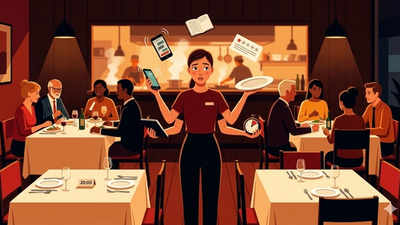
During a typical day, especially during check-in and check-out peak hours, a single receptionist simultaneously greets guests at the counter, answers phone calls, monitors incoming reservations, responds to inquiries arriving by email or WhatsApp, handles a noise complaint from the room next door, and tries to find a free dinner table for a couple who didn't book in advance. All of this with a smile, in English, because the guest doesn't speak Croatian.
Guest satisfaction then is not a question of competence. It is a question of capacity.
What Falls on the Front Desk's Shoulders
The hotel front desk is the heart of every accommodation property: the first and last point of contact with the guest. But also the place where almost everything converges: questions, complaints, requests, reservations, cancellations. If we look at what the front desk actually handles every day, the picture becomes clear:
Repetitive inquiries without end. "What time is breakfast?" "Is there free parking?" "Can I have a late checkout?" "Where is the nearest restaurant?" Each of these questions takes a minute or two. Multiplied by the number of guests throughout the day, that amounts to hours of working time spent on answers that don't change from Monday to Sunday.
24/7 availability with a limited team. Guests don't choose when they'll have a question or a problem. The night shift at smaller and medium-sized hotels often means one person covering the front desk, parking, and emergency situations. Every call at two in the morning is stressful for the hotel, but also for the guest waiting for an answer.
Language barriers. International guests are increasingly common, and not every receptionist is equally fluent in English, German, Italian, or Arabic. Misunderstandings in communication, especially around reservation terms, cancellation policies, or additional charges, can escalate into dissatisfaction, and dissatisfaction into a bad review.
Overbooking and reservation errors. Double bookings, incorrectly entered dates, guests who arrive a day earlier than planned. Although these situations are rare, when they occur they require a lot of time and diplomatic skill to resolve on the spot. And most often at a moment when the front desk is already under pressure.
Online inquiries waiting for a response. A growing number of guests write before arrival: via Booking.com, direct email, WhatsApp, or Instagram. Responding to those channels, while physical check-ins are simultaneously happening, falls on the same team. Keeping track of all communication channels (reviews, email, chat, phone) alongside a standard front desk team is becoming increasingly difficult, and unanswered inquiries directly affect the hotel's perception.
Why This Is a Growing Problem
Modern guests are accustomed to speed. They use apps every day that respond in less than a second, booking platforms available at any moment, digital services that never sleep. When the same guest arrives at a hotel and has to wait (for a response, for check-in, for the resolution of an inquiry) the contrast becomes ever more noticeable. Slowness in response, especially to online reviews and inquiries, directly affects brand perception. The data confirms this: according to a Touch Stay study, 69% of guests cite communication as the key factor influencing whether they will leave a positive review. A satisfied guest who didn't receive timely information doesn't write a review. Or writes a negative one.
The result? The receptionist is overloaded. The guest is frustrated. And no one is to blame, but the problem remains and is reflected in the hotel's business.
What Changes When a Hotel Introduces an AI Chat Assistant
A quantitative analysis of hotel AI chatbots published in 2025 in the Center for Management Science Research showed concrete results: negative feedback dropped from 28% to 12%, guest satisfaction scores rose from 3.8 to 4.5, and response time was reduced from 30 to just 18 seconds.
It is important to emphasize that an AI chat assistant is not a replacement for a receptionist. It is better described as a digital colleague who takes over repetitive, predictable tasks and thereby frees the real team for what truly requires a human touch: resolving complex situations, personal contact, empathy.
Concretely, this means several changes:
Automatic responses to standard questions. A guest asks what time breakfast is and receives an answer within seconds, whether it's 2:00 PM or 3:00 AM. The receptionist retains capacity for everything else.
Multilingual communication without extra effort. The AI assistant can communicate in a dozen languages without the hotel needing to hire specialized staff or rely on Google Translate.
Continuous availability. Inquiries that arrive at night, on weekends, or during holidays don't wait until morning. The guest gets an answer, and the receptionist doesn't carry the burden of every night shift.
Less pressure on the team during check-in and check-out peaks. The AI assistant takes over repetitive inquiries that would otherwise consume hours of working time, meaning the receptionist during check-in peaks has significantly more focus available for the guests in front of them.
The One Man Band Can Finally Rest
A receptionist shouldn't have to be an acrobat. They should be the face of the hotel: calm, available, and focused on the guest in front of them. Technology like ChatNav doesn't change what the hotel is; it changes how much one person has to carry alone.
The AI assistant takes over the repeating rhythm. The receptionist holds the melody.