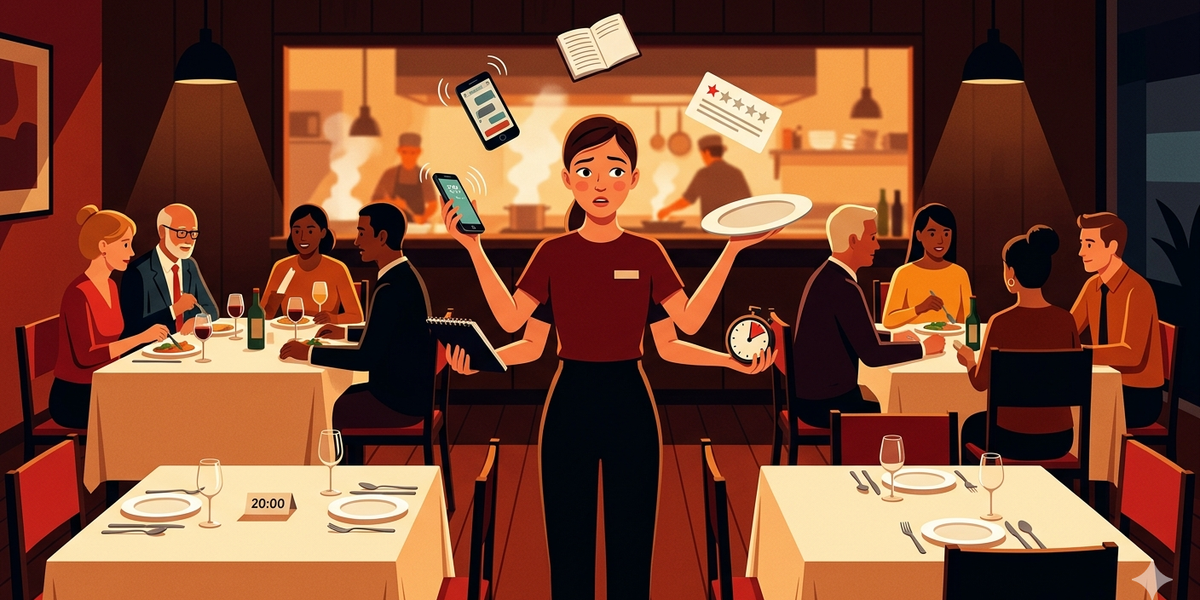
Friday evening, 7:30 PM. Reservations are full, the chef is in full swing, and waitress Maja is running between three tables, the bar, and the kitchen. Somewhere in that moment, the phone rings. And rings. And rings.
Nobody picks up.
That call was most likely a reservation for two, maybe four. Or an inquiry about allergies. Or a guest wanting to confirm their arrival. Now it doesn't matter — they're gone. And with them, potential revenue that will never reach the register.
The Restaurant as a Juggler Without a Safety Net
The hotel reception has its own one-man-band receptionist who handles check-ins, calls, and messages in parallel. The webshop has a customer service team that responds to numerous inquiries and complaints. In a restaurant, the situation is even more complex: everything happens simultaneously, in real time, under time pressure that has no parallel in any other industry.
A waiter simultaneously takes an order, notes special requests, answers a question about the menu, watches for finished orders from the kitchen, and makes a trip to the bar for drinks. The host arranges tables, manages the waiting list, greets arriving guests, and tries to answer the phone that is now ringing for the fifth time. The shift manager handles a complaint, checks inventory, and watches the clock.
Every mistake in that network — a missed call, a wrong order, a long wait, an unattended table — directly translates into lost revenue or a bad review. Or both.
Where the Money You Never Noticed Is Being Lost
The Phone Nobody Answers
A Breez study published in 2025 found that the average restaurant misses 43% of incoming phone calls. In other words, nearly every other call goes unanswered — not because staff don't want to answer, but because they're in the middle of service, behind the bar, or in the kitchen.
The financial math is uncomfortable: assuming 20% of missed callers planned a reservation or order worth $50, the annual loss per location can reach as much as $292,000. A number that sounds unrealistic — until you translate it into missed reservations, empty tables, and lost guests who called the competition instead.
Reservations That Don't Show Up
The so-called no-show reservations are the second major cost that most restaurants don't measure precisely. According to data from OpenTable, in major cities an average of 20% of guests don't show up for their reservation: without prior cancellation, without notice. Every such table sits empty during a period when it could have been filled.
Depending on the type of restaurant and the average bill, the cost of one no-show ranges between $28 and $120 per person. For a restaurant that sees a dozen such situations per week, that's a significant operational loss that doesn't appear in any report — because reports only record what happened, not what could have been.
Waiting That Drives Guests Away
Waiting is perhaps the most uncomfortable chapter. According to data from a Lightspeed Commerce study, nearly 30% of guests left the restaurant before placing an order because the wait was too long. These guests don't write reviews and don't complain — they simply leave, and with them goes every chance of a return visit.
Reviews That Go Unanswered
A negative review without a response speaks just as loudly to potential new guests as the review itself. An analysis of more than 100,000 restaurant reviews (RightResponse AI) revealed a striking difference: restaurant chains respond to nearly 60% of reviews, while individual locations hover around 15%. That gap is no accident — chains have communications teams and tools. Independent restaurants have Maja, who is already running between three tables.
Meanwhile, negative reviews in hospitality are growing: Trustpilot data shows a 3% increase in negative ratings since April 2024, alongside a simultaneous 4% drop in positive ones. A restaurant that doesn't monitor and respond to reviews gradually loses its reputational edge over those that do so systematically.
Why 'We Manage Somehow' Is No Longer a Strategy
A restaurant with fifteen tables and three waiters can operate purely on improvisation. A restaurant heading toward fuller days, higher traffic, and seasonal peaks cannot.
Neither overtime hours nor adding staff solves the structural problem: too many communication channels, too many repetitive tasks, and too many missed contacts that never show up in the register.
How an AI Assistant Helps Restaurants
An AI assistant in a restaurant is not a robotic waiter. It's a digital collaborator that takes over everything that is predictable, repetitive, and time-sensitive — freeing up staff for what requires a human touch.
Reservations and confirmations without missed calls. A guest calls at 2:00 PM or messages at 11:00 PM. The AI assistant receives the request, confirms the time slot, and if needed, sends a reminder the day before. No missed calls, no empty tables that could have been filled.
Reducing no-shows with automatic reminders. A reminder sent 24 hours before a reservation isn't a courtesy — it's an operational tool. Restaurants that use it report it as a direct contributor to occupancy. A guest who receives a reminder will typically either confirm their arrival or cancel in time, and a timely cancellation is a table that can be offered to another guest.
Responding to reviews without a backlog. The assistant monitors reviews on platforms, classifies sentiment, and suggests or automates the first response. A 15% response rate can be increased without hiring additional staff — but it requires systematic coverage that doesn't depend on whether the manager has five free minutes.
Inquiries about the menu, allergens, and opening hours. However many times a guest asks 'do you have gluten-free options' or 'are you open on Sundays,' the assistant answers accurately and immediately. The waiter stays at the table.
Managing the wait. During peak hours, the assistant can inform guests about current occupancy, estimated wait time, and table availability — reducing the uncertainty that drives guests away before they even sit down.
Every Missed Call Has a Price
43% of calls unanswered. 20% of reservations that don't show up. 30% of guests who leave before ordering. Each of those numbers has a cost, and all three share one thing in common: they are not the result of bad food or bad staff. They are the result of capacity that couldn't keep up with the pace.
Restaurants that recognize this and invest in tools that expand that capacity will have an advantage — not only in traffic, but in reputation and guest satisfaction. An AI assistant like ChatNav is one such tool: available when staff aren't, fast when service is in full swing, and consistent even when the restaurant is booked to the last table.